
OpenAI Ads Product Feeds for Shopify: What Merchants Need to Know
- 13 Jul, 2026
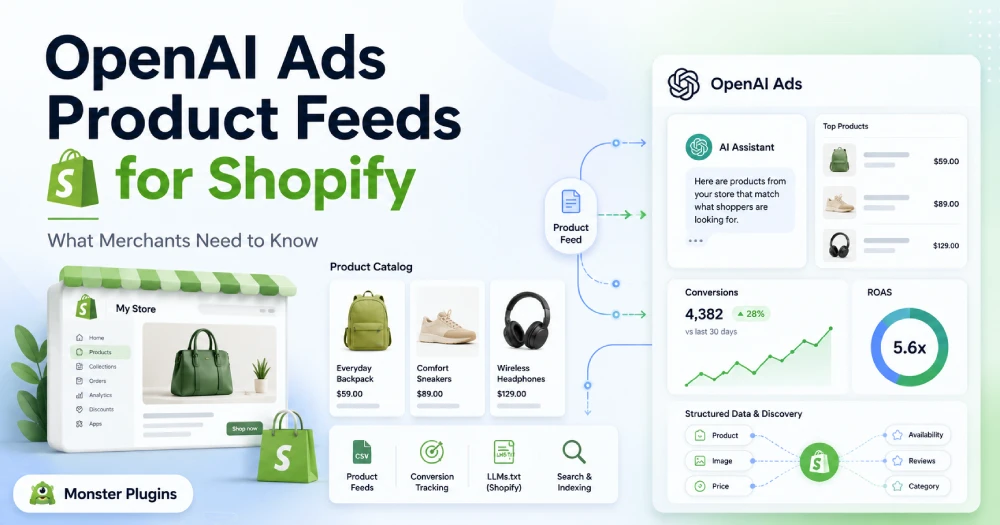
AI-powered shopping is changing how customers discover products online. Shoppers are no longer only searching on traditional search engines — they are also asking AI tools for recommendations, comparisons, and buying guidance.
For Shopify merchants, this creates a new opportunity: preparing product data for AI-powered commerce and advertising channels.
One of the newest opportunities is OpenAI Ads. For merchants who want to prepare for OpenAI Ads product-feed campaigns, the most important starting point is a structured, accurate, and regularly updated product feed.
In this guide, we’ll explain what OpenAI Ads product feeds are, why they matter for Shopify stores, and how IndexNow: OpenAI Ads & LLMs helps merchants prepare their catalogs without custom development.
What Is an OpenAI Ads Product Feed?
An OpenAI Ads product feed is a structured catalog that contains the product information OpenAI Ads needs for feed-based campaigns.
Instead of creating a separate ad manually for every product, a product feed allows OpenAI Ads to read product data from your catalog and use eligible products in ad placements.
A product feed can include information such as:
-
Product titles
-
Product descriptions
-
Prices
-
Availability
-
Product images
-
Destination URLs
-
Product metadata
In other words, your feed tells OpenAI Ads what products you sell, what each product is, whether it is available, and where shoppers should go if they click.
OpenAI’s product-feed documentation describes product feeds as merchant catalogs used to create and measure product-feed ads. You can read more in OpenAI’s official documentation on product feeds.
Why Shopify Merchants Should Pay Attention
Shopify merchants already manage rich product data inside their stores. Product titles, descriptions, prices, variants, images, inventory, and URLs are all part of the catalog.
The challenge is making that product data available in the right format for new channels like OpenAI Ads.
A Shopify store may have thousands of products, frequent price changes, seasonal inventory, changing availability, and new product launches. Manually preparing and maintaining a feed for a new advertising platform can quickly become time-consuming.
That is why feed readiness matters.
A well-maintained product feed helps your store:
-
Keep product data structured for OpenAI Ads product-feed campaigns
-
Keep prices and availability aligned with your current Shopify catalog
-
Reduce manual feed work when your catalog changes
-
Prepare for emerging AI commerce and advertising workflows
-
Support conversion tracking for measuring ad performance
Being ready does not guarantee approval or ad placement. OpenAI controls access to the OpenAI Ads program and campaign eligibility. But having your feed prepared can help remove feed-related setup work when your account is ready to connect.
How OpenAI Ads Product-Feed Campaigns Work
OpenAI’s help documentation explains that product-feed campaigns let retail advertisers upload a product feed in Ads Manager and create ads based on that catalog.
At a high level, the workflow looks like this:
-
Create a feed connection in OpenAI Ads Manager
-
Upload a product feed through the required feed connection
-
Let Ads Manager process and validate the feed
-
Create a product-feed campaign
-
Select or filter products for the campaign
-
Create an ad template
-
Review and launch the campaign
OpenAI’s documentation also notes that product feeds are uploaded through SFTP, and Ads Manager provides the SFTP connection details after the feed is created.
For Shopify merchants, this means the important preparation work is not just “having products.” It is having a feed that is correctly formatted, current, and ready for the OpenAI Ads workflow.
Product Feed vs. Conversion Tracking
Product feeds and conversion tracking solve different parts of the advertising workflow.
A product feed tells OpenAI Ads what products are available to advertise.
Conversion tracking helps measure what happens after someone interacts with an ad, such as a purchase or other key store event.
For OpenAI Ads, merchants should think about both:
-
Product feed readiness helps prepare the catalog side.
-
Conversion tracking helps measure sales, revenue, and campaign performance.
A feed without tracking can make it harder to evaluate performance. Tracking without a feed does not prepare your product catalog for feed-based ads.
The strongest setup includes both.
How IndexNow: OpenAI Ads & LLMs Helps
IndexNow: OpenAI Ads & LLMs helps Shopify merchants prepare for OpenAI Ads product-feed workflows from one app.
The app is designed to help with:
-
OpenAI Ads product feed generation
Generate an OpenAI Ads-compatible product feed from your Shopify catalog. -
Feed updates
Keep product data aligned as your catalog changes. -
Feed submission readiness
Prepare your feed for the OpenAI Ads workflow once your Ads Manager connection is available. -
Conversion tracking
Enable tracking support for purchases and other key store events. -
LLMs.txt generation
Maintain an LLMs.txt file to help AI crawlers better understand your store. -
IndexNow submissions
Notify Bing and other IndexNow-enabled search engines when products, collections, or pages change.
This gives Shopify merchants a broader AI and search visibility toolkit — not just a feed generator.
Why LLMs.txt and IndexNow Still Matter
OpenAI Ads product feeds are important, but they are only one part of a broader AI commerce strategy.
LLMs.txt helps provide structured information for AI crawlers and AI-powered systems. It can help clarify what your store sells and which pages matter.
IndexNow helps notify supported search engines like Bing when your store content changes. For ecommerce stores, this can be useful when products are added, updated, removed, or restocked.
Together, product feeds, LLMs.txt, and IndexNow support a broader goal:
Make your Shopify store easier for search engines, AI crawlers, and emerging commerce platforms to understand.
Important Notes Before You Start
Before preparing your Shopify store for OpenAI Ads, keep these points in mind:
-
OpenAI Ads access and approval are controlled by OpenAI.
-
A compatible product feed does not guarantee approval or ad delivery.
-
Product feed ads are separate from organic product discovery.
-
Product data should be accurate, complete, and kept up to date.
-
Conversion tracking is important for measuring campaign performance.
-
IndexNow: OpenAI Ads & LLMs is built by Monster Plugins and is not an official OpenAI app.
The goal is preparation: making sure your Shopify catalog is ready for the OpenAI Ads feed workflow when your account is approved and connected.
Get Your Shopify Catalog Ready for OpenAI Ads
OpenAI Ads introduces a new product-feed opportunity for merchants, and Shopify stores should start thinking about catalog readiness now.
A strong setup should include:
-
An OpenAI Ads-compatible product feed
-
Automatic feed updates
-
Conversion tracking
-
LLMs.txt generation
-
Real-time IndexNow submissions for search discovery
With IndexNow: OpenAI Ads & LLMs, you can prepare your product feed, LLMs.txt, IndexNow submissions, and conversion tracking from one app.
Ready to prepare your Shopify catalog for OpenAI Ads? Learn more on our OpenAI Ads Product Feeds for Shopify page or install the app from the Shopify App Store.
Related Articles