
What Is LLMs.txt for Shopify Stores?
- 13 Jul, 2026
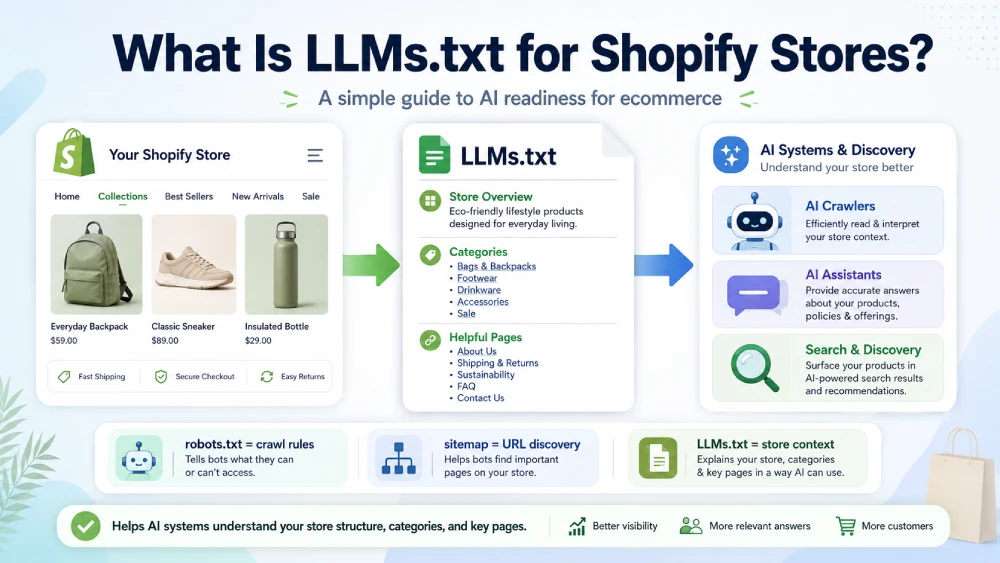
AI-powered discovery is changing how shoppers find products online.
Customers are no longer only using traditional search engines. They are also asking AI tools for recommendations, comparisons, buying advice, and product research.
For Shopify merchants, this raises a new question:
How can AI systems better understand what your store sells?
One emerging answer is LLMs.txt.
In this guide, we’ll explain what LLMs.txt is, why Shopify stores may want one, what it should include, and how IndexNow: OpenAI Ads & LLMs helps generate and maintain it automatically.
What Is LLMs.txt?
LLMs.txt is a text file designed to give large language models and AI crawlers a clearer overview of a website.
It is usually placed at:
https://yourstore.com/llms.txt
The goal is simple: provide a structured, machine-readable summary of the most important parts of your site.
For a Shopify store, that can include information such as:
-
What the store sells
-
Important collections
-
Key product categories
-
Useful store pages
-
Policies or support pages
-
Important product discovery links
Think of LLMs.txt as a guide for AI systems.
It does not replace your website. It does not replace your sitemap. It does not guarantee rankings or recommendations.
But it can help organize your store information in a format that is easier for AI systems to read and understand.
Why Shopify Stores Should Care About LLMs.txt
Shopify stores are built for shoppers first.
That means your store may include:
-
Product grids
-
Collection filters
-
Navigation menus
-
JavaScript
-
Theme code
-
Apps
-
Reviews
-
Popups
-
Promotions
These elements can be useful for customers, but they may make it harder for AI crawlers to quickly understand your store structure.
LLMs.txt gives AI systems a cleaner summary.
For ecommerce stores, this can be useful because AI systems may need to understand:
-
What products you sell
-
Which categories matter most
-
Which collections are important
-
Which pages explain your policies
-
Which URLs represent key store content
-
How your catalog is organized
As AI-assisted shopping grows, structured signals like LLMs.txt can become part of a broader AI readiness strategy.
What Should an LLMs.txt File Include?
A useful LLMs.txt file should be clear, organized, and focused on the most important content.
For Shopify stores, it may include sections such as:
-
Store overview
-
Product categories
-
Important collections
-
Featured products
-
Buying guides
-
Shipping and return policies
-
Contact or support pages
-
Brand information
-
Other useful ecommerce pages
Here is a simplified example:
# Example Shopify Store

> A Shopify store selling outdoor gear, hiking equipment, and camping accessories.

## Product Categories

- [Backpacks](https://example.com/collections/backpacks): Hiking and travel backpacks for outdoor use.
- [Camping Tents](https://example.com/collections/tents): Lightweight and family camping tents.
- [Water Bottles](https://example.com/collections/water-bottles): Reusable bottles and hydration products.

## Helpful Pages

- [Shipping Policy](https://example.com/policies/shipping-policy): Shipping options and delivery times.
- [Return Policy](https://example.com/policies/refund-policy): Return and refund information.
- [Contact](https://example.com/pages/contact): Customer support contact page.
The goal is not to include every single page.
The goal is to provide a useful, curated guide to your store.
LLMs.txt vs Robots.txt
LLMs.txt is sometimes confused with robots.txt, but they are not the same thing.
Robots.txt tells crawlers which parts of a website they are allowed or not allowed to crawl.
LLMs.txt helps AI systems understand important website content.
In simple terms:
| File | Main Purpose |
|---|---|
| robots.txt | Gives crawl access instructions |
| sitemap.xml | Lists URLs for search engines |
| llms.txt | Provides a curated guide for AI systems |
A robots.txt file is about crawler access.
A sitemap is about URL discovery.
LLMs.txt is about context and understanding.
For Shopify merchants, these files can work together, but they serve different purposes.
LLMs.txt vs Sitemap.xml
A Shopify sitemap usually contains many URLs across your store, such as products, collections, pages, and blog posts.
That is useful for search engines.
But a sitemap does not usually explain which pages matter most, what your store sells, or how AI systems should interpret your catalog.
LLMs.txt is more curated.
Instead of listing every URL, it can highlight the most useful content for understanding your store.
For example:
-
Your sitemap may include every product page.
-
Your LLMs.txt may highlight your main product categories and important collections.
That makes LLMs.txt a helpful complement to your sitemap, not a replacement.
LLMs.txt vs Product Feeds
LLMs.txt is also different from a product feed.
A product feed contains structured product data for commerce and advertising workflows. It may include titles, prices, images, availability, destination URLs, and product metadata.
An LLMs.txt file provides a curated overview of important store content and links.
For Shopify stores preparing for AI commerce, both can be useful:
-
A product feed helps advertising and commerce platforms understand product-level data.
-
LLMs.txt helps AI systems understand the store structure and important resources.
If you are preparing for OpenAI Ads product-feed campaigns, product feeds are the catalog side.
If you are preparing for broader AI readiness, LLMs.txt can help provide context.
Does LLMs.txt Improve SEO?
LLMs.txt should not be treated as a guaranteed SEO ranking factor.
It does not guarantee:
-
Higher Google rankings
-
More traffic
-
AI recommendations
-
ChatGPT visibility
-
Product discovery
-
OpenAI Ads approval
The better way to think about LLMs.txt is as an AI readiness signal.
It helps organize your store information in a format that AI systems may find easier to process.
That can support a broader strategy that also includes:
-
Strong product data
-
Clear product descriptions
-
Accurate prices and availability
-
Structured product feeds
-
IndexNow submissions
-
Helpful content
-
Clean store navigation
LLMs.txt is not a magic file.
It is one useful part of a larger AI and search visibility foundation.
Why LLMs.txt Matters for Ecommerce Stores
Ecommerce stores change often.
Products are added. Prices change. Inventory changes. Collections are updated. Seasonal pages come and go.
That means an LLMs.txt file should not be created once and forgotten.
For Shopify stores, it should stay aligned with your current catalog and important store pages.
A useful LLMs.txt file should reflect:
-
Current product categories
-
Active collections
-
Important policy pages
-
Relevant buying guides
-
Current store structure
-
Useful product discovery paths
If your LLMs.txt file becomes outdated, it may point AI systems toward old, irrelevant, or unavailable content.
That is why automatic generation and maintenance can be valuable.
What Should Shopify Merchants Avoid?
When creating LLMs.txt for a Shopify store, avoid these common mistakes:
-
Listing every product URL without structure
-
Including outdated or discontinued collections
-
Adding private or sensitive information
-
Using vague descriptions
-
Duplicating your entire sitemap
-
Making unsupported claims about rankings or AI visibility
-
Forgetting to update the file when your catalog changes
LLMs.txt should be public, useful, and intentional.
Do not include anything that should not be publicly accessible.
How IndexNow: OpenAI Ads & LLMs Helps
IndexNow: OpenAI Ads & LLMs helps Shopify merchants generate and maintain LLMs.txt automatically.
The app supports:
-
LLMs.txt generation
Create a structured file that helps AI crawlers understand your store. -
Automatic maintenance
Keep the file aligned with your store content as your catalog changes. -
OpenAI Ads product feeds
Generate OpenAI Ads-compatible product feeds from your Shopify catalog. -
Conversion tracking
Help measure key store events from OpenAI Ads campaigns. -
IndexNow submissions
Notify Bing and other IndexNow-enabled search engines when products, collections, or pages change.
This makes the app useful for merchants who want to prepare for AI commerce, search discovery, and OpenAI Ads product-feed workflows from one place.
Shopify LLMs.txt Checklist
Use this checklist when preparing LLMs.txt for your Shopify store:
-
The file is available at
/llms.txt -
The store description is clear
-
Important collections are included
-
Product categories are described accurately
-
Key policy pages are linked
-
Helpful buying guides or educational pages are included
-
Links are current and working
-
Sensitive or private information is not included
-
The file is updated as your store changes
-
Expectations are realistic and not based on guaranteed rankings
A good LLMs.txt file should make your store easier to understand, not more complicated.
Prepare Your Shopify Store for AI Discovery
LLMs.txt gives Shopify merchants a simple way to organize important store information for AI systems.
It does not replace SEO, product feeds, sitemaps, or strong product content.
But it can support a broader AI readiness strategy by helping AI crawlers understand what your store sells and which pages matter.
With IndexNow: OpenAI Ads & LLMs, you can generate and maintain LLMs.txt automatically, while also preparing OpenAI Ads product feeds, conversion tracking, and IndexNow submissions from one app.
Learn more on our OpenAI Ads Product Feeds for Shopify page or install the app from the Shopify App Store.
Related Articles