
ChatGPT Product Discovery vs OpenAI Ads for BigCommerce: What Merchants Should Know
- 14 Jul, 2026
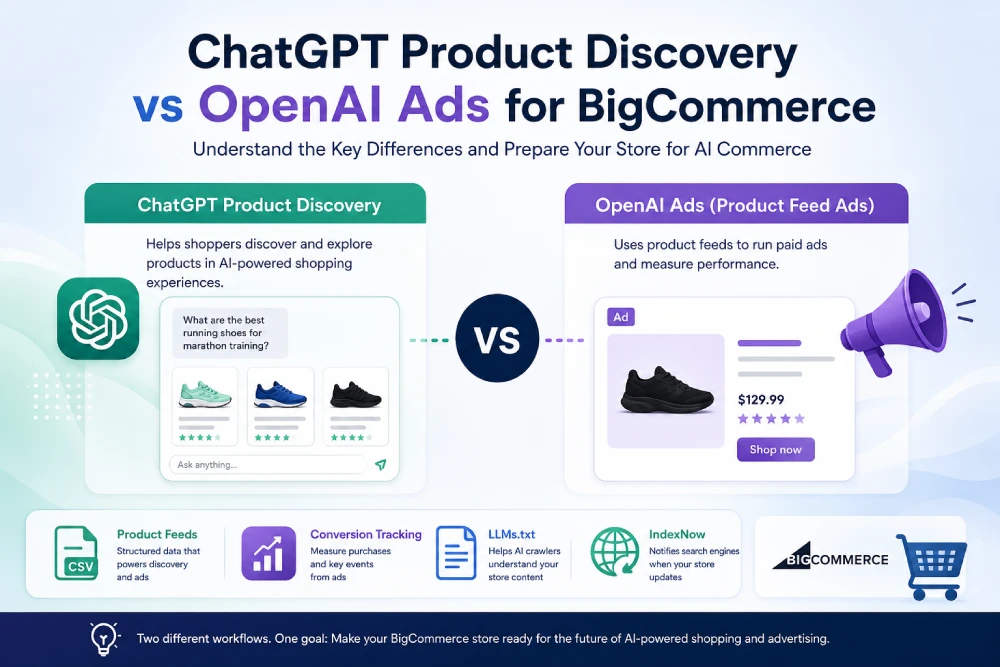
AI commerce is creating new ways for shoppers to discover products.
Instead of only searching through traditional search engines, shoppers are asking ChatGPT for recommendations, comparisons, buying ideas, and product research.
For BigCommerce merchants, this creates two related but different opportunities:
ChatGPT product discovery and OpenAI Ads.
Both involve product data.
Both can depend on structured product feeds.
Both can help merchants prepare for AI-powered shopping experiences.
But they are not the same thing.
In this guide, we’ll explain the difference between ChatGPT product discovery and OpenAI Ads, why BigCommerce merchants should understand both, and how IndexNow & ChatGPT Product Feeds helps prepare your catalog for AI commerce workflows.
What Is ChatGPT Product Discovery?
ChatGPT product discovery refers to shopping experiences where products can appear as shoppers ask ChatGPT for recommendations or product ideas.
For example, a shopper might ask:
-
“What are good gifts for a new homeowner?”
-
“Find waterproof hiking boots under $150.”
-
“Compare office chairs for back support.”
-
“What are good skincare products for dry skin?”
-
“Show me minimalist watches for men.”
In these cases, ChatGPT may help users explore options, compare products, and decide what to buy.
For merchants, product discovery is about making product data available and understandable so products can be represented accurately in AI-powered shopping experiences.
OpenAI’s merchant page explains that product feeds can help merchants share product data so shoppers can discover and evaluate products in ChatGPT, with purchases completed on merchant-owned websites or apps.
For BigCommerce stores, that means your catalog data matters.
Your titles, descriptions, prices, availability, images, and product URLs all help explain what your products are and when they are relevant.
What Is OpenAI Ads?
OpenAI Ads is the paid advertising side.
OpenAI Ads product-feed campaigns use a merchant catalog to create and measure product-feed ads.
Instead of manually creating ads for every individual product, a merchant can connect a product feed so eligible products can be used in ad campaigns.
A product-feed ad workflow may involve:
-
A structured product feed
-
Ads Manager access
-
Feed upload through SFTP
-
Campaign settings
-
Product filters
-
Ad templates
-
Conversion tracking
-
Performance measurement
OpenAI Ads is not the same as organic product discovery.
OpenAI’s product-feed campaign documentation notes that products from feeds uploaded for product-feed ads are eligible for ads during the beta and do not appear in organic ChatGPT conversations through that workflow.
That distinction is important for BigCommerce merchants.
An OpenAI Ads product feed helps prepare your catalog for paid product-feed campaigns.
It should not be treated as a guarantee of organic ChatGPT visibility.
The Simple Difference
The easiest way to understand the difference is this:
| Workflow | Main Purpose |
|---|---|
| ChatGPT product discovery | Helps products appear in AI shopping and product discovery experiences |
| OpenAI Ads | Uses product feeds for paid product-feed advertising campaigns |
| Product feed | Supplies structured catalog data |
| Conversion tracking | Measures shopper actions after ad engagement |
ChatGPT product discovery is about being discoverable in AI-assisted shopping.
OpenAI Ads is about paid advertising and campaign measurement.
Both benefit from clean product data.
Both may involve product feeds.
But they are separate workflows with different rules, approval paths, and expectations.
Why BigCommerce Merchants Should Understand the Difference
BigCommerce merchants may hear similar phrases used in different ways:
-
ChatGPT product feed
-
OpenAI product feed
-
OpenAI Ads product feed
-
AI product discovery
-
ChatGPT shopping
-
Product-feed ads
These phrases can sound interchangeable, but they do not always mean the same thing.
That can create confusion.
A merchant might assume that preparing an OpenAI Ads product feed automatically means their products will appear organically in ChatGPT.
That is not the right expectation.
A merchant might also assume that ChatGPT product discovery is an ad product.
That is not always correct either.
The better way to think about it is:
-
Product discovery helps AI shopping systems understand and present products.
-
OpenAI Ads helps merchants run paid product-feed campaigns.
-
Product feeds provide structured catalog data for one or more workflows.
-
Conversion tracking helps measure paid campaign performance.
Understanding the difference helps merchants prepare without overpromising results.
Why Product Feeds Matter in Both Workflows
Even though ChatGPT product discovery and OpenAI Ads are different, they share one important foundation:
structured product data.
A product feed helps organize catalog information in a machine-readable format.
For a BigCommerce store, that can include:
-
Product title
-
Product description
-
Product URL
-
Product image
-
Price
-
Sale price
-
Availability
-
Brand
-
Category
-
SKU or product identifier
-
Product metadata
This matters because AI-powered systems and advertising platforms need accurate product data to understand what your store sells.
A vague or incomplete catalog is harder to interpret.
A clean, current, well-structured catalog is easier to use across discovery and advertising workflows.
Product Discovery Is Not the Same as Advertising
This is one of the most important points for merchants.
A product appearing in a discovery experience is not the same as a paid ad.
Product discovery is usually driven by relevance, product data, shopper context, availability, and the quality of the information available to the AI system.
Advertising is campaign-driven.
With OpenAI Ads, merchants may work with:
-
Campaign budgets
-
Campaign settings
-
Feed connections
-
Ad groups
-
Product filters
-
Product eligibility
-
Ad templates
-
Conversion events
-
Performance reporting
Those are advertising concepts.
Organic product discovery and paid product-feed ads may both use product data, but they are not the same channel.
For BigCommerce merchants, this means both workflows should be approached separately.
Prepare your catalog for product discovery.
Prepare your feed and tracking for OpenAI Ads.
Do not assume one automatically guarantees the other.
Where BigCommerce Product Data Fits In
Your BigCommerce catalog is the starting point.
A BigCommerce store may include:
-
Products
-
Categories
-
Brands
-
Product images
-
SKUs
-
Product options
-
Pricing
-
Sale pricing
-
Inventory status
-
Product descriptions
-
Custom fields
-
Product URLs
This data can power product feeds, but only if it is mapped and structured correctly.
For example, OpenAI Ads product-feed workflows may need clear information about titles, descriptions, prices, availability, images, and destination URLs.
ChatGPT product discovery may also benefit from complete, accurate, and current product information.
That means merchants should treat product data quality as a core AI commerce task.
What Makes a Product Feed Useful?
A useful product feed should be accurate, complete, and updated.
For BigCommerce merchants, that means:
-
Product titles should be descriptive.
-
Product descriptions should be clear.
-
Prices should match the store.
-
Sale prices should be current.
-
Availability should reflect actual inventory.
-
Product images should be valid and high quality.
-
Destination URLs should lead to live product pages.
-
Categories should be organized logically.
-
Brand data should be consistent.
-
Product metadata should help clarify product meaning.
A product feed is not just a technical file.
It is a structured version of your catalog.
If the feed is weak, outdated, or incomplete, the systems that rely on it may receive weak, outdated, or incomplete information.
Why Conversion Tracking Belongs to the Ads Workflow
Conversion tracking is most important for paid advertising.
A product feed tells OpenAI Ads what products exist.
Conversion tracking helps measure what happens after users interact with ads.
That may include events such as:
-
Page views
-
Product views
-
Cart actions
-
Checkout actions
-
Purchases
-
Revenue
For BigCommerce merchants, conversion tracking can help answer questions like:
-
Are ads driving purchases?
-
Which campaigns are producing revenue?
-
Which products are performing?
-
Are shoppers completing checkout?
-
Is paid traffic converting?
This is different from product discovery.
Product discovery is about being found and represented accurately.
Conversion tracking is about measuring paid performance.
Where SFTP Fits Into OpenAI Ads
OpenAI Ads product-feed workflows use SFTP for feed uploads.
In OpenAI Ads Manager, merchants create a feed connection and receive SFTP connection details.
The product feed is then uploaded through that SFTP connection.
This is part of the paid ads workflow.
It is not the same as simply having a public product feed URL.
For BigCommerce merchants, this matters because a complete OpenAI Ads setup may involve:
-
Generating the product feed
-
Keeping the feed updated
-
Entering SFTP connection details
-
Uploading the feed through the Ads Manager workflow
-
Supporting conversion tracking
-
Monitoring feed and campaign readiness
Automation can make this workflow much easier.
Instead of manually rebuilding and uploading catalog data, the feed can stay aligned with your BigCommerce store.
How ChatGPT Product Discovery Fits Into AI Readiness
ChatGPT product discovery is part of a broader shift toward AI-assisted shopping.
Shoppers may ask AI tools for help instead of browsing category pages or typing short keywords into a search engine.
That changes how merchants should think about product information.
Product data should be:
-
Clear
-
Structured
-
Detailed
-
Accurate
-
Current
-
Easy to interpret
For BigCommerce stores, this means product titles and descriptions should be written for both humans and machines.
A product name like:
Classic Backpack
is useful.
But a product name like:
Classic Everyday Backpack - Water-Resistant 20L Travel Bag
gives more context.
The same applies to descriptions, categories, brands, and product metadata.
Better product data can support both shoppers and AI-powered discovery systems.
How LLMs.txt Supports AI Understanding
Product feeds are not the only part of AI readiness.
LLMs.txt can also help AI crawlers understand your store.
An LLMs.txt file provides a structured overview of important website content.
For a BigCommerce store, it may include:
-
Store overview
-
Main product categories
-
Important brand pages
-
Helpful buying guides
-
Shipping and return pages
-
Contact or support pages
-
Key store resources
LLMs.txt is not a replacement for product feeds.
It does not guarantee product discovery.
It does not guarantee search rankings.
But it can give AI systems a clearer summary of your store structure and important pages.
That makes it a useful part of a broader AI commerce readiness strategy.
How IndexNow Supports Search Discovery
IndexNow is another important piece.
BigCommerce stores change often.
Products are added. Prices change. Inventory changes. Categories are updated. Pages are edited.
IndexNow helps notify supported search engines like Bing when URLs change.
That can include:
-
Product pages
-
Category pages
-
Brand pages
-
Store pages
-
Blog posts
IndexNow does not guarantee instant indexing or higher rankings.
But it can help supported search engines discover updates faster.
For merchants, that means IndexNow supports search discovery while product feeds and LLMs.txt support AI commerce readiness.
These pieces work together, but they solve different problems.
Common Misunderstandings
Here are some common misunderstandings BigCommerce merchants should avoid.
“If I create an OpenAI Ads feed, my products will appear organically in ChatGPT.”
Not necessarily.
OpenAI has stated that products from feeds uploaded for product-feed ads are eligible for ads during the beta and do not appear in organic ChatGPT conversations through that workflow.
“ChatGPT product discovery and OpenAI Ads are the same thing.”
They are related, but separate.
Product discovery is about AI shopping visibility.
OpenAI Ads is about paid advertising campaigns.
“A product feed guarantees visibility.”
No.
A product feed helps structure your catalog, but it does not guarantee ad delivery, organic visibility, rankings, clicks, or sales.
“Conversion tracking is the same as a product feed.”
No.
A product feed sends catalog data.
Conversion tracking measures shopper actions and campaign performance.
“LLMs.txt replaces product feeds.”
No.
LLMs.txt helps summarize store context.
Product feeds provide product-level catalog data.
Both can be useful.
How IndexNow & ChatGPT Product Feeds Helps
IndexNow & ChatGPT Product Feeds helps BigCommerce merchants prepare for both product discovery and OpenAI Ads workflows.
The app supports:
-
ChatGPT product feed readiness
Helps generate a structured product feed from your BigCommerce catalog for OpenAI-related product discovery workflows. -
OpenAI Ads-compatible product feeds
Helps prepare your catalog for OpenAI Ads product-feed campaigns. -
Automatic feed updates
Keeps product feed data aligned as products, prices, images, and availability change. -
Feed submission workflow
Supports the OpenAI Ads feed connection workflow once your Ads account is approved and connection details are available. -
Conversion tracking
Helps measure purchases and other key store events from OpenAI Ads campaigns. -
LLMs.txt generation
Creates and maintains a structured LLMs.txt file to help AI crawlers understand your store. -
IndexNow submissions
Notifies Bing and other IndexNow-enabled search engines when products, categories, or pages change.
This gives BigCommerce merchants one place to manage multiple pieces of AI commerce readiness.
Which Should BigCommerce Merchants Prepare First?
The best first step is product data quality.
Before thinking about discovery or advertising, make sure your catalog is clean.
Start with:
-
Clear product titles
-
Complete descriptions
-
Accurate prices
-
Current availability
-
High-quality images
-
Working product URLs
-
Organized categories
-
Consistent brand data
Then prepare your product feed.
Once your feed is ready, you can use it as the foundation for OpenAI-related commerce workflows.
After that, enable conversion tracking for OpenAI Ads measurement and make sure LLMs.txt and IndexNow are active.
A practical order looks like this:
-
Clean up product data.
-
Generate a structured product feed.
-
Keep the feed updated automatically.
-
Prepare for ChatGPT product discovery workflows.
-
Connect to OpenAI Ads when approved.
-
Enable conversion tracking.
-
Maintain LLMs.txt.
-
Submit product and page updates through IndexNow.
This approach avoids confusion and gives your store a stronger foundation.
BigCommerce AI Commerce Checklist
Use this checklist to prepare your store:
-
Product titles are descriptive
-
Product descriptions are complete
-
Prices are accurate
-
Availability is current
-
Images are high quality
-
Product URLs are live
-
Categories are organized
-
Brands are consistent
-
Product feed data is generated automatically
-
Feed updates stay aligned with catalog changes
-
OpenAI Ads SFTP details can be added when approved
-
Conversion tracking is available
-
LLMs.txt is generated and maintained
-
IndexNow submissions are active
-
Expectations are realistic and do not depend on guaranteed visibility
This checklist helps prepare your store for product discovery, advertising, and search visibility without treating any one channel as guaranteed.
Prepare Your BigCommerce Store for AI Commerce
ChatGPT product discovery and OpenAI Ads are related, but they are not the same thing.
ChatGPT product discovery is about helping shoppers find and evaluate products in AI-powered shopping experiences.
OpenAI Ads is about paid product-feed advertising campaigns and performance measurement.
Product feeds help both workflows by turning your BigCommerce catalog into structured product data.
Conversion tracking supports paid campaign measurement.
LLMs.txt helps AI crawlers understand your store.
IndexNow helps supported search engines discover updates faster.
With IndexNow & ChatGPT Product Feeds, BigCommerce merchants can prepare product feeds, support OpenAI Ads conversion tracking, generate LLMs.txt, and automate IndexNow submissions from one app.
Learn more on our OpenAI Ads Product Feeds for BigCommerce page or install the app from the BigCommerce App Marketplace.
Related Articles